A standard framework for defining costs and risks in every transaction
What are Incoterms? Incoterms, or International Commercial Terms, are a series of pre-defined rules for international transactions. Established by the International Chamber of Commerce (ICC), applicable worldwide, and widely used by exporters across all sectors, Incoterms enable businesses to determine which party is liable for the costs and risks associated with an export.
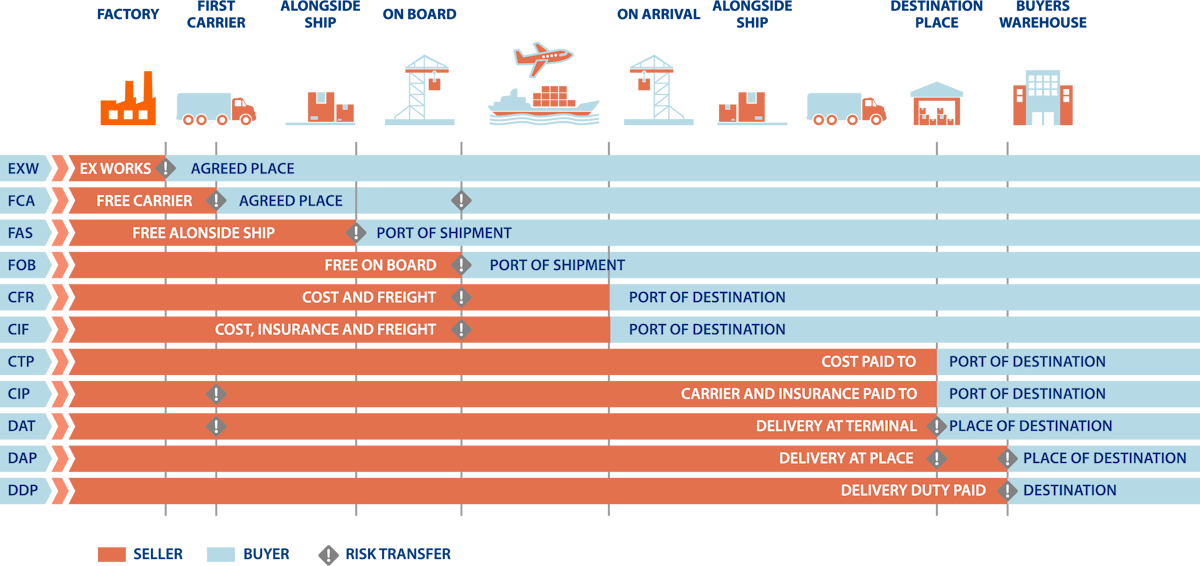
Incoterms cover every stage of the shipping process: shipment, ground and air transportation, customs clearance, and insurance (accounting for the value of goods, distance, and modes of transportation), from when goods leave the seller's facility until the buyer receives and pays for them. In short, Incoterms define whether the buyer or seller is responsible for goods and liabilities at each step.
The 11 types of Incoterms operate on a sliding scale of responsibility between buyer and seller for transportation and delivery. In 10 of the 11 terms, the buyer pays import duties. The only exception is Delivered Duty Paid (DDP), where the seller assumes this cost. Incoterms are updated approximately every decade to reflect changing commercial patterns and emerging risks. The most recent edition, issued in 2020, addressed geopolitical challenges, clarified security-related obligations, and redefined "place of delivery."
Why Incoterms matter: While it can seem quite technical, Incoterms give every commercial transaction a recognized framework, and are designed to remove ambiguity or room for (mis)interpretation. What’s more, because they define when goods and risks are transferred from the seller to the buyer, Incoterms can be used to maximize working capital and improve inventory management. This is especially useful in industries with narrow margins, or when companies need to increase working capital and secure cash flow (say ahead of an investment, or when costs might rise).
A practical example: Say you are a producer of specialized electrical components used in consumer appliances. Your factories are in Japan, and one of your biggest customers is in Germany. The most convenient terms for you might be Ex Works, in which your customer would collect the electrical components from your sites and your liability ends as soon as they leave your premises. However, your customer might not want to take on all the costs of transporting the goods (which includes insurance and customs duties) – they might prefer Delivered at Place or Delivery Duty Paid. You might negotiate and meet in the middle – the most widely use Incoterms in B2B trade are Free On Board, and Cost, Insurance & Freight.
Using Incoterms today
In addition to raising costs and diversifying customers and suppliers, the Allianz Trade Global Survey revealed an unexpected trend: as companies generally try to push costs onto suppliers, buyers' Incoterms preferences are shifting toward Delivered Duty Paid (DDP). Under DDP, the seller is responsible for managing all logistics and costs, including customs, to the buyer's location. Surprisingly, the survey found a willingness among sellers to accept DDP terms.
This is especially true in the wholesale and retail sector (where 28% of respondents use the DDP Incoterm the most), and less so in commodities (12%). One possible explanation is that companies are more accustomed to negotiating and sharing costs in B2B transactions. The only exception to this is in the United States, where companies continue to favor “Cost, Insurance & Freight.”
We are also seeing companies negotiating more intensely about the Incoterms governing each transaction. Both exporters and importers can expect this to continue, given ongoing uncertainties in global trade conditions and the tendency towards shifting or sharing risks. The small print in commercial contracts will prove to be ever more important as buyer and sellers try to minimize risk while protecting their relationships and business.
Your partner for global trade insights
In these conditions, having the right partners for global trade that can provide insight into macroeconomic trends as well as local market intelligence can be particularly beneficial to companies. Our team of economists, specialized in sectors and regions, coupled with credit analysts with deep knowledge of local business conditions and insolvency risk, are here to help customers navigate these headwinds, manage credit risk effectively, and protect their business.